High-RPM YouTube Niches: What Those Ranked Lists Leave Out
Search for the highest-paying topics on YouTube and you will find a dozen ranked lists, most of them with a dollar figure printed next to each category. Finance near the top, gaming somewhere near the bottom, and a strong hint that you could move up the table simply by changing what you film.
Those lists are not exactly wrong. The categories they name really do attract advertisers with deeper pockets. But they describe a result without describing the mechanism behind it, and creators who act on them tend to land in a niche they cannot sustain, holding a subject that is harder to make than the one they left.
I have been making faceless videos since 2017, mostly for viewers in the US, the UK, Germany and Japan. I have watched people move into personal finance for the rate alone more than once. Here is what the lists leave out.
An ad rate is not a property of a topic
RPM – revenue per thousand views – is an outcome, not a setting. Your topic is one input into it. The others are the country your viewers watch from, the time of year, your video format, how long people stay, and how attractive your particular audience is to the businesses buying attention.
Which means a finance video watched by an audience no advertiser is trying to reach earns roughly what any other video would. The category is not paying you. The auction is.
So it helps to reframe the decision. When you choose a subject, you are not choosing a payout. You are choosing which advertisers are allowed to bid for the space beside your video.
Why some categories are bid on harder
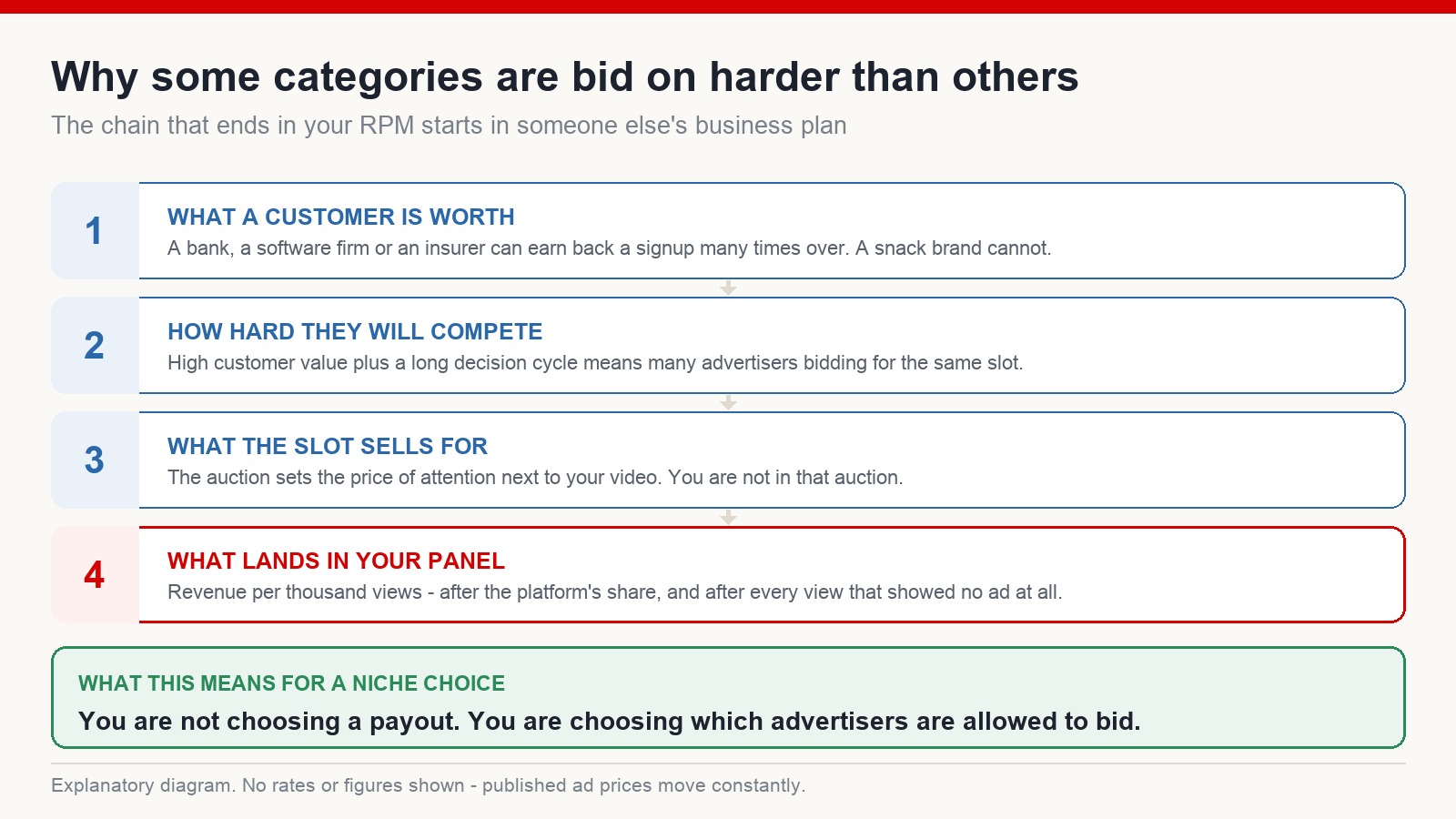
Work backwards from the advertiser and the whole thing stops being mysterious.
A bank, a broker, an insurer or a software company can earn back the cost of a single signup many times over, and their customers take weeks to decide. That combination – high customer value plus a long decision cycle – is what makes a business willing to pay repeatedly for attention it might not convert today. A snack brand has neither, so it bids accordingly.
Two consequences follow, and both matter more than any ranked list:
- What raises the price is a viewer who is plausibly in the market for something expensive. Not the subject label on your channel.
- The rate moves on the advertiser’s calendar, not yours. Budgets refresh, campaigns end, sectors pull back. You will feel that in your analytics and it will have nothing to do with your work that month.
The categories that keep coming up, and what each one costs you
These are the groups creators most often report as commercially strong. I have written the trade-off next to each, because the lists never do.
- Personal finance and business. Consistently the most competitive advertising space, and consistently the heaviest duty of care. This is territory where being casually wrong can genuinely damage someone. If you do not have real competence here, the honest version of this niche is journalism and explanation, not advice – and you should say so on the channel.
- Psychology and self-development. Evergreen, endlessly reusable, and it ages slowly. It is also crowded, and it drifts: the moment your content moves from habits and communication toward diagnosis or treatment, you are in health territory with all the responsibility that carries.
- Science, space and the natural world. Long shelf life, international by default, and it works well without a face on camera. The cost is research time and footage. Sourcing visuals you are actually licensed to use is slower and more expensive than beginners expect, and errors in this niche get corrected loudly in your comments.
- Education and professional skills. Languages, software, career skills, programming, AI tooling. Viewers come back, which is rare and valuable. But you have to genuinely know the thing, and anything tied to a specific product goes out of date the moment that product ships an update.
- Formats that do not lean on language. Visual storytelling, animation, sparse narration. This travels across borders more easily, and it is a legitimate approach. What it is not is a shortcut – removing words does not create retention, it just removes one of your tools for holding attention.
Two things the lists quietly fold in
The first is audience geography. A published rate for a category is usually an average across an audience mix you do not have. Where your viewers watch from does at least as much work as what you cover.
The second is competition, and it is the honest counterweight to the whole idea. A category is expensive to advertise in because it is valuable, which means the people who know that subject best are already publishing in it. High commercial value and low competition almost never sit in the same place.
Longer videos are not a lever
A longer video creates more opportunity for ads to be served – but only if people are still watching when those moments arrive. Padding a script to reach a runtime target produces a long video with a short average view duration, which is worse on both counts.
Let the subject decide the length. Then work on the things that actually keep someone in their seat: a clear promise in the first fifteen seconds, a structure they can feel, and no dead stretch in the middle.
The test I would actually use
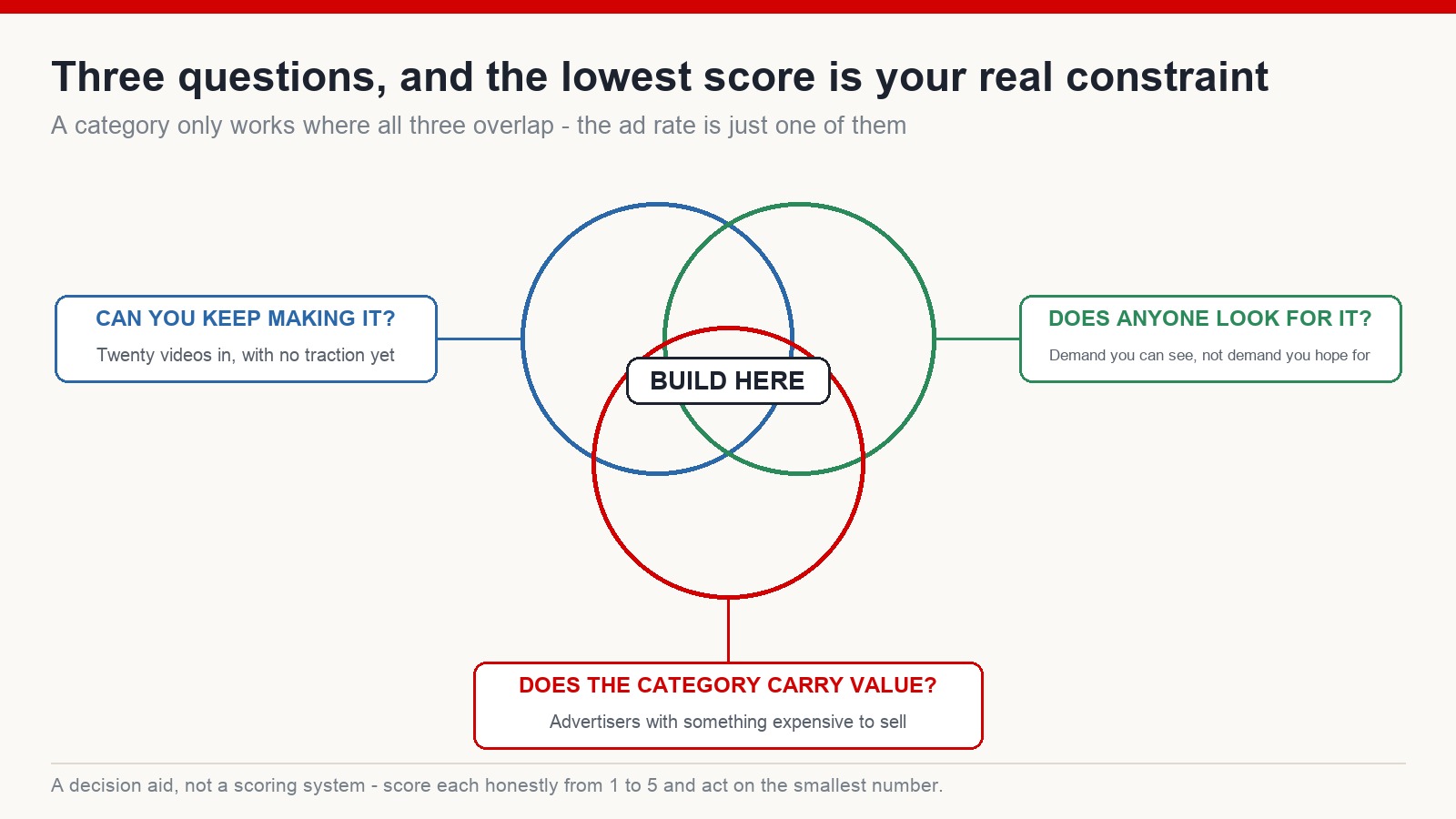
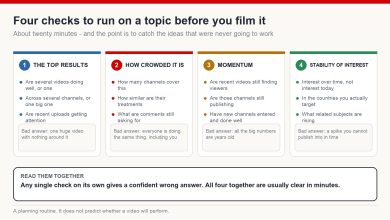
Three questions, scored honestly from one to five. Your lowest score is the thing that will stop you, not your highest.
- Can you still be making this in twelve months? Twenty uploads in, with the numbers still flat. That is the real test of a niche, and enthusiasm at the start tells you nothing about it.
- Does an audience already look for this? Demand you can observe – existing channels, search behaviour, comment sections full of unanswered questions – rather than demand you have assumed.
- Does the category carry commercial weight? Are there businesses with something expensive to sell to these viewers?
Most people who chase a ranked list score high on the third and low on the first. That is the failure mode: a well-priced channel that stops publishing in month four.
What to do this week
- Pick three candidate subjects, not one.
- For each, write twenty video titles from memory, without research. If you stall at eight, you have your answer about sustainability.
- Check whether people are actively searching for those titles, and who is already answering them well.
- Ask whether the category expects credentials or lived experience you do not have. If it does, either build that or choose the explanatory angle deliberately.
- Commit to twenty videos before you judge anything, and compare results against your own earlier videos rather than against a published rate from someone else’s channel.
There is no magic niche. Topic, audience country, video quality, format, season and advertiser demand all move the number, and most of them move without asking you. What you control is choosing a subject with durable value, understanding the people who watch it, and improving the work. The rate is the consequence of that, not the goal.
Which topic has the highest RPM?
There is no fixed ranking, and any table you find is a snapshot of particular channels at a particular time. Finance, education, technology and specialist professional subjects are commonly reported as commercially strong compared with broad entertainment – but the audience behind the views matters as much as the label.
Should I choose a niche purely for the ad rate?
No. If you cannot produce good work in it consistently, the rate advantage never gets a chance to compound. A channel that stops publishing earns nothing at any rate.
Do longer videos always earn more?
No. Length only helps when viewers stay. Runtime should serve the content rather than the other way round.
What should a beginner start with?
Start where you can produce steady value, then check demand and how strong the existing competition is. That order builds something sustainable; chasing a short-lived trend rarely does.
Why did my RPM drop when nothing changed?
Usually the advertiser side moved, not yours – seasonal budgets, a shift in where your viewers are watching from, or a change in your traffic mix. Treat any single month as weather, and look at trends over quarters instead.
If you want to see how this thinking is applied to building a channel for an English-speaking audience end to end, that is what I teach at mmoyoutube.com. Results vary between channels, and platform policies change – treat every figure you read anywhere, including here, as history rather than a forecast.